Industry
Carbon Capture, Utilization, and Storage (CCUS) are essential technologies to help achieve the ambition of net zero anthropogenic greenhouse gas emissions by 2050.
CCUS is a collective term used to describe various methods of trapping the carbon dioxide (CO2) produced by burning fossil fuels and storing it permanently or utilizing it. Fossil fuels like coal, oil, and natural gas form the largest single source of global greenhouse gas emissions, primarily due to the carbon dioxide produced.
CCUS technology can lower carbon dioxide (CO2) from being released from point sources into the atmosphere or removes it directly from the atmosphere. CCUS is a critical emissions reduction technology that can be applied across the energy system.
Our mission is to reduce CO2 emissions from industrial operations and power facilities throughout the United States. Our proprietary patched CCUS technology is critical to achieving a global transition to a low-carbon energy system in the coming years.
Our company values innovation, accountability, integrity, and our inherent responsibility to the environment to reduce the amount of carbon dioxide in the atmosphere utilizing CCUS technology.
Technology
The joint venture’s objective is developing the first CCUS pilot program in the United States that converts CO2 emissions from a fossil fuel-powered industrial plant to a solid form of calcium carbonate. The objective is to capture CO2 emissions using the installed CCUS pilot program and achieve a technology readiness level 7 (“TRL 7”).
The joint venture will install and own the CCUS modules. The patented technology captures 99% of the CO2 and subsequently converts the CO2 into commercial grade and storable calcium carbonate. The CO2 converted to storable calcium carbonate (CaCO3) qualifies for US Tax Code Section 45Q tax credits.
The installed CCUS JV modules will capture carbon emissions directly from the targeted plant. The CCUS technology utilizes calcium hydroxide (Ca(OH)2), water, and Carbon Dioxide (CO2) gas to generate calcium carbonate (CaCO3) in a storable solid form.
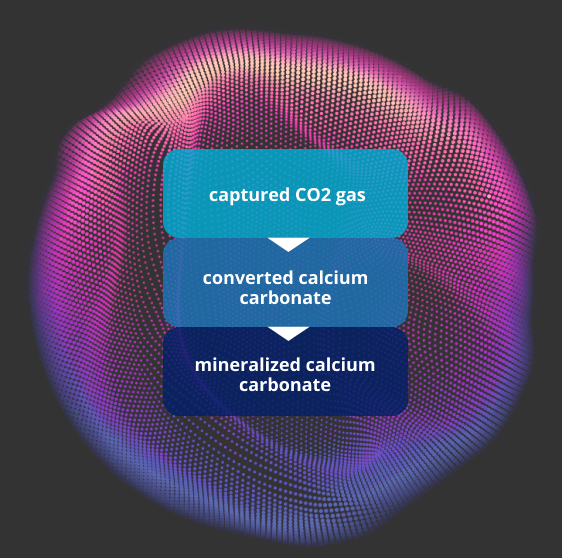
The CCUS JV technology concept is to mineralize calcium carbonate from captured CO2 gas extracted from the flue gas of a fossil fuel burning process, such as an industrial plant or coal-burning power plant. Laboratory tests use a single-coil tubular reactor where CO2 gas is inserted together with brine water in a single-phase flow. As the mineralization process starts instantly, it reaches up to 100% conversion of CO2 to calcium carbonate. A metallic catalyst is used to dissolve in the brine water to improve the conversion speed and efficiency of the mineralization.
The technology uses solid metal materials for catalyzing the hydration of carbon dioxide. It also relates to the methods and apparatus for hydrating carbon dioxide and capturing carbon. The solid metal materials in most cases will be nickel nanoparticles. The invention finds application in the sequestration of carbon dioxide either at the point of release or from the atmosphere. Brine water with nickel nanoparticle suspension (30 ppm) had 11 times higher absorption capacity than CO2 in deionized brine water with a reaction time of 60 seconds.
The technology uses the components in flue gas from a fossil burning power or industrial plant, optimized with mass balance and heat transfer parameters needed to minimize the energy required to capture all components in the flue gas including CO2. It uses cryogenic distillation with a turboexpander energized from liquification of nitrogen. Liquid O2 and CO2 are used as a cooling medium for flue gas from the burner stack, removing water from the flue gas through condensation while transforming CO2 to gaseous form before further processing through CO2 mineralization.
The CCUS equipment is installed by contracted engineers and contracted construction workforce. The equipment will be monitored and serviced by onsite CCUS JV technicians. The technicians will directly report to CCUS JV engineers and sales representatives. Each fully operational CCUS facility will require a technician workforce to monitor and service the installed CCUS equipment.